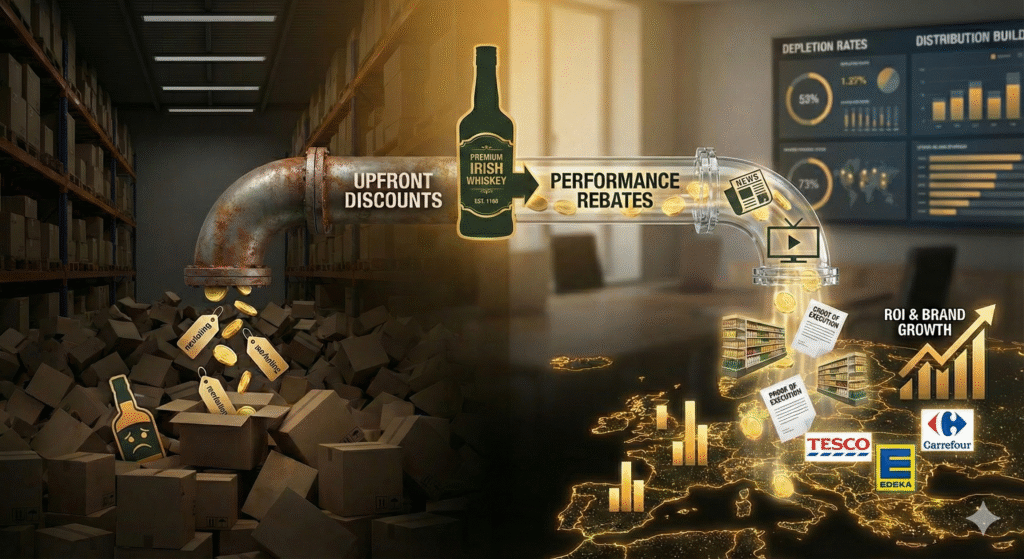
Optimizing Trade Allowances in the European Spirits Market
Expanding an independent spirits brand across Europe is a thrilling milestone. For many Irish whiskey manufacturers, breaking into markets like Germany, France, Czech or Poland means relying on the local expertise of third-party distributors.
To fuel this expansion, brands typically offer distributors a financial incentive — often in the form of upfront invoice discounts — to fund local marketing and advertising. It is a standard industry practice. It is also one of the fastest ways to bleed margin.
If not managed with strict governance, these marketing allowances quickly morph from a strategic investment into a pure margin leak. Distributors, over time, often absorb the discount as extra profit, and the brand owner is left wondering why their European “marketing budget” isn’t moving bottles off the shelf.
Here’s how spirits brands can transition from blindly funding inventory to building performance-based, high-ROI distributor partnerships.
The Illusion of the Upfront Discount
The traditional model is simple: A brand ships 1,000 cases of whiskey to a Dutch distributor and applies a 10% discount on the invoice, earmarked for “local marketing.”
The problem? Once the discounted invoice is paid, the brand loses all leverage.
- Cash Flow Hit: The brand loses cash immediately upon shipment, regardless of whether the marketing ever happens.
- The “Pantry Loading” Effect: Distributors may order heavily to capture the discount, stockpiling inventory without actually driving consumer demand.
- Brand Dilution: When the distributor does spend the money, the brand often has zero visibility into the messaging, risking off-brand activations that dilute premium equity.
Shifting the Paradigm: Pay for Performance
To reclaim control, C-Suite and Finance leaders need to fundamentally restructure these agreements. Instead of giving an upfront discount, brands should move to a back-end rebate or claims model.
Under this structure, the distributor pays the full invoice price. The brand only releases marketing funds after the distributor provides verifiable Proof of Execution (PoE) — such as photos of retail displays, invoices from local ad agencies, or receipts from tasting events.
The Financial and Accounting Advantages
This shift isn’t just about control; it drastically changes the financial health of the brand:
- Working Capital: Holding the funds until PoE is provided keeps cash in the brand’s bank account, not the distributor’s.
- Protecting the Top Line: Standard accounting rules treat upfront invoice discounts as a reduction of Gross Revenue (a Below-The-Line trade spend). By shifting to a back-end model where the distributor provides a distinct, approved marketing service, the spend can be classified as an Operating Expense (Above-The-Line). This preserves top-line revenue — a crucial metric for brand valuation.
- Tax Compliance: For an Irish manufacturer dealing with EU distributors, shifting to a “marketing service” model invokes cross-border B2B tax rules. Instead of adjusting the VAT on physical goods, the distributor invoices the brand for a service without local VAT, and the Irish entity accounts for it via the EU Reverse Charge mechanism. (Note: Irish Revenue strictly looks at “substance over form,” so your contracts must match the reality of the transaction).
Navigating the Legal Minefield: EU Competition Law
When tightening the reins on distributor marketing, brands must be careful not to cross European legal lines. The most critical risk is Resale Price Maintenance (RPM).
Under EU Competition Law, a manufacturer cannot dictate the exact price an independent distributor charges their wholesalers or retailers. Even if you are funding a specific promotional campaign, those marketing funds can never be used as leverage to force a distributor to adhere to a Minimum Advertised Price (MAP) or Recommended Retail Price (RRP). Distributors must retain absolute freedom to set their own margins.
Tracking What Matters: KPIs for True ROI
How do you know if your new marketing arrangement is actually working? You have to stop looking at shipments and start looking at the street.
A successful distributor partnership focuses on leading indicators:
- Depletion Rates: The volume of whiskey leaving the distributor’s warehouse to go to the on-trade (bars) or off-trade (retailers). If shipments are high but depletions are low, your marketing isn’t working.
- Rate of Sale (RoS): How quickly the product turns over on the retail shelf.
- Distribution Build: The number of net-new premium bar placements or retail listings secured using the marketing funds.
The Bottom Line
Trusting your European distributors is essential, but trust is not a financial strategy. By moving away from upfront discounts and implementing strict guidelines around Brand Control, Proof of Execution, and Depletion tracking, spirits brands can ensure that every Euro spent abroad is actively building their brand, rather than subsidizing someone else’s bottom line.
Are you currently undergoing an expansion into new markets? Daunted about how to fund your band marketing efforts? Let’s talk!
Email us at info@saoirseconsultants.com, or call us on +1 214 230 1706